A wise old Lakota-Sioux Woman

My photo
The old photo to your left is an important one:Chief's Red Cloud and Sitting Bull. (Update: a fellow blogger notified me and corrected the Warrior next to Red Cloud is American Horse. Also see picture of American Horse in full headress at bottom of this blog) I'm a Lakota-Sioux ,born and raised in Central Wyoming on the Arapho/ Shoshone Rez. My wisdom comes from the school of hard knocks,and the paths I choose to take. Along with the advice and stories from my elders, my road has lead me here.

Tuesday, December 16, 2008

Lakota natives withdraw from treaties w/ whitey's


Share/Save/Bookmark I am so very proud of my nation! The pride and strength lives on!

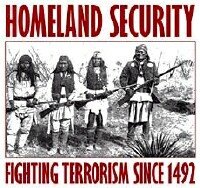
WASHINGTON — The Lakota Indians, who gave the world legendary warriors Sitting Bull and Crazy Horse, have withdrawn from treaties with the United States.
"We are no longer citizens of the United States of America and all those who live in the five-state area that encompasses our country are free to join us,'' long-time Indian rights activist Russell Means said.
A delegation of Lakota leaders has delivered a message to the State Department, and said they were unilaterally withdrawing from treaties they signed with the federal government of the U.S., some of them more than 150 years old.
The group also visited the Bolivian, Chilean, South African and Venezuelan embassies, and would continue on their diplomatic mission and take it overseas in the coming weeks and months.
Lakota country includes parts of the states of Nebraska, South Dakota, North Dakota, Montana and Wyoming.
The new country would issue its own passports and driving licences, and living there would be tax-free - provided residents renounce their U.S. citizenship, Mr Means said.
The treaties signed with the U.S. were merely "worthless words on worthless paper," the Lakota freedom activists said.


Withdrawing from the treaties was entirely legal, Means said.
"This is according to the laws of the United States, specifically article six of the constitution,'' which states that treaties are the supreme law of the land, he said.
"It is also within the laws on treaties passed at the Vienna Convention and put into effect by the US and the rest of the international community in 1980. We are legally within our rights to be free and independent,'' said Means.
The Lakota relaunched their journey to freedom in 1974, when they drafted a declaration of continuing independence — an overt play on the title of the United States' Declaration of Independence from England.
Thirty-three years have elapsed since then because "it takes critical mass to combat colonialism and we wanted to make sure that all our ducks were in a row,'' Means said.
One duck moved into place in September, when the United Nations adopted a non-binding declaration on the rights of indigenous peoples — despite opposition from the United States, which said it clashed with its own laws.
"We have 33 treaties with the United States that they have not lived by. They continue to take our land, our water, our children,'' Phyllis Young, who helped organize the first international conference on indigenous rights in Geneva in 1977, told the news conference.
The U.S. "annexation'' of native American land has resulted in once proud tribes such as the Lakota becoming mere "facsimiles of white people,'' said Means.
Oppression at the hands of the U.S. government has taken its toll on the Lakota, whose men have one of the shortest life expectancies - less than 44 years - in the world.
Lakota teen suicides are 150 per cent above the norm for the U.S.; infant mortality is five times higher than the U.S. average; and unemployment is rife, according to the Lakota freedom movement's website.

Monday, December 15, 2008

Let it snow!


Share/Save/Bookmark It's 6 o clock in the evening, the Nevada storm front is moving over us with a lite snow starting to cover the land. In my neck of the woods, the town closes up around 8pm, the lights go dim and the smell of the wood stoves come and go. I love this land and the folks who live here, all living in harmony. This is the high desert and land of 4 seasons, the view is breath taking! We go ATVing in the spring and summer. Fishing and boating, swimming and jet skiing during fishing season. Hiking for those who can. This is the outback of NW Arizona! Land of Lake Mead, the Colorado River, and the Grand Canyon! We have gold mines, Turquoise mines, the land of thunder eggs and beautiful stones. Heck we even had the burning man festival here this year.
But this snow stuff has only happened maybe 7 or 8 times since I moved here 6 yr ago. It'll be melted off by noon tomorrow.Snow is cool to watch, to sit by our fire and see the beauty of it all. Life is good!

I'm a Native!


Share/Save/Bookmark (To some of you who may be discusted by the name, Indian put on this story, please remember this is a very old story. While we now go by Native in the modern world, we must pay our respects. I do not remember where I found or was given this story and if someone knows from which it came, let me know and I'll add the persons name to it.)
~~~~~~~~~~~~~~~~~~~~~~~~~~~~~~~~~~~~~~~~~~~~~~~~~~~~~~~~~~~~~
How often have you heard or said "I'm part Indian"?
If you have, then some Native American elders have something to teach you. A very touching example was told by a physician from Oregon who discovered as an adult that he was Indian.
This is his story. Listen well:

Some twenty or more years ago while serving the Mono and Chukchanse and Chownumnee communities in the Sierra Nevada, I was asked to make a house call on a Mono elder. She was 81 years old and had developed pneumonia after falling on frozen snow while bucking up some firewood.
I was surprised that she had asked for me to come since she had always avoided anything to do with the services provided through the local agencies. However it seemed that she had decided I might be alright because I had helped her grandson through some difficult times earlier and had been studying Mono language with the 2nd graders at North Fork School.
She greeted me from inside her house with a Mana' hu, directing me into her bedroom with the sound of her voice. She was not willing to go to the hospital like her family had pleaded, but was determined to stay in her own place and wanted me to help her using herbs that she knew and trusted but was too weak to do alone. I had learned to use about a dozen native medicinal plants by that time, but was inexperienced in using herbs in a life or death situation.
She eased my fears with her kind eyes and gentle voice. I stayed with her for the next two days, treating her with herbal medicine (and some vitamin C that she agreed to accept). She made it through and we became friends.
One evening several years later, she asked me if I knew my elders. I told her that I was half Canadian and half Appalachian from Kentucky. I told her that my Appalachian grandfather was raised by his Cherokee mother but nobody had ever talked much about that and I didn't want anyone to think that I was pretending to be an Indian. I was uncomfortable saying I was part Indian and never brought it up in normal conversation.
"What! You're part Indian?" she said. "I wonder, would you point to the part of yourself that's Indian. Show me what part you mean." I felt quite foolish and troubled by what she said, so I stammered out something to the effect that I didn't understand what she meant. Thankfully the conversation stopped at that point. I finished bringing in several days worth of firewood for her, finished the yerba santa tea she had made for me and went home still thinking about her words.
Some weeks later we met in the grocery store in town and she looked down at one of my feet and said, "I wonder if that foot is an Indian foot. Or maybe it's your left ear. Have you figured it out yet?" I laughed out loud, blushing and stammering like a little kid.
When I got outside after shopping, she was standing beside my pick-up, smiling and laughing. "You know" she said, "you either are or you aren't. No such thing as part Indian. It's how your heart lives in the world, how you carry yourself. I knew before I asked you. Nobody told me. Now don't let me hear you say you are part Indian anymore."
She died last year, but I would like her to know that I've heeded her words. And I've come to think that what she did for me was a teaching that the old ones tell people like me, because others have told me that a Native American elder also said almost the same thing to them. I know her wisdom helped me to learn who I was that day and her words have echoed in my memory ever since.
And because of her, I am no longer part Indian, I'm an Indian!
~~~~~~~~~~~~~~~~~~~~~~~~~~~~~~~~~~~~~~~~~~~~~~~~~~~~~~~~~~~~~